


Shopping Cart
Remove All Your shopping cart is currently empty

Synonyms: Ubiquinone-10, CoQ10
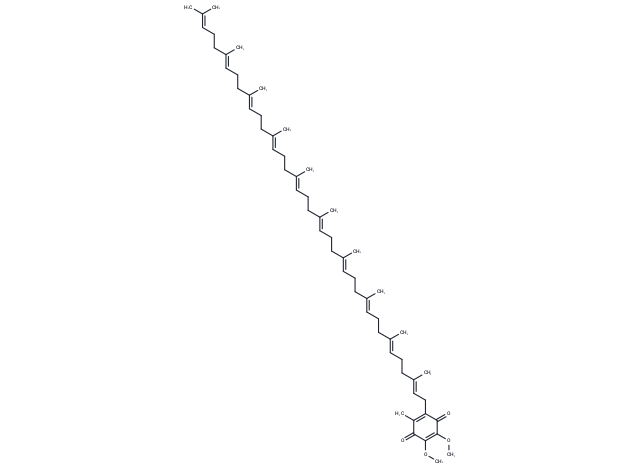
| Pack Size | Price | USA Stock | Global Stock | Quantity |
|---|---|---|---|---|
| 200 mg | $42 | In Stock | In Stock | |
| 500 mg | $91 | - | In Stock | |
| 1 g | $136 | - | In Stock | |
| 5 g | $197 | - | In Stock |
| Description | Coenzyme Q10 (CoQ10) is a naturally occurring lipid-soluble quinone compound derived from Fusarium oxysporum. Coenzyme Q10 functions as an electron carrier in the mitochondrial respiratory chain, sustaining mitochondrial energy metabolism. Coenzyme Q10 is applicable in research on mitochondrial dysfunction, oxidative stress damage, cardiovascular diseases, and neurodegenerative disorders. |
| In vitro | Methods: Isolated rat liver mitochondria were treated with Coenzyme Q10 (16, 32, 48, 64, 80 μg/mL), and inorganic phosphate release was measured to reflect ATPase activity. Results: PCK and Coenzyme Q10 at all concentrations increased mitochondrial ATPase activity. [1] Methods: Primary mouse peritoneal macrophages were pretreated with Coenzyme Q10 (20 µM) for 2 hours, then stimulated with LPS (1 µg/mL) for 6, 12, or 18 hours. Reactive oxygen species (ROS) were detected using the DCFH-DA fluorescent probe. Results: Coenzyme Q10 treatment significantly inhibited LPS-induced ROS production in macrophages. [2] |
| In vivo | Methods: Coenzyme Q10 (600 mg/kg/day) was administered via oral gavage starting 3 days prior to myocardial infarction in mice, once daily, continuing until 28 days post-surgery. Results: Coenzyme Q10 significantly reduced the area of myocardial fibrosis following myocardial infarction and alleviated myocardial cell hypertrophy in the infarct margin zone. [2] |
| Synonyms | Ubiquinone-10, CoQ10 |
| Molecular Weight | 863.34 |
| Formula | C59H90O4 |
| Cas No. | 303-98-0 |
| Smiles | C(/C=C(/CC/C=C(/CC/C=C(/CC/C=C(/CC/C=C(/CC/C=C(/CC/C=C(/CC/C=C(/CC/C=C(/CCC=C(C)C)\C)\C)\C)\C)\C)\C)\C)\C)\C)C=1C(=O)C(OC)=C(OC)C(=O)C1C |
| Relative Density. | 0.9145 g/cm3 (Estimated) |
| Storage | Store at low temperature,The compound is unstable in solution. Please use soon Powder: -20°C for 3 years Shipping with blue ice/Shipping at ambient temperature. | ||||||||||
| Solubility Information | DMF: 1 mg/mL (1.16 mM), Sonication and heating are recommended.  DMSO: < 1 mg/mL (insoluble or slightly soluble), The compound is unstable in solution, please use soon. | ||||||||||
Solution Preparation Table | |||||||||||
DMF
Note : The dilution table applies only to solid products. For liquid products, please calculate the stock solution based on the stated concentration and/or density. | |||||||||||
 For example, if the intended dosage is 10 mg/kg for animals weighing 20 g , with a dosing volume of 100 μL per animal, and a total of 10 animals are to be administered, using a formulation of
  10% DMSO+ 40% PEG300+ 5% Tween 80+ 45% Saline/PBS/ddH2O , the resulting working solution concentration would be 2 mg/mL.
Dissolve 2 mg of the compound in 100 μL DMSO to obtain a stock solution at a concentration of 20 mg/mL . If the required concentration exceeds the compound's known solubility, please contact us for technical support before proceeding.
1) Add 100 μL of the DMSO stock solution to 400 µL PEG300 and mix thoroughly until the solution becomes clear.
2) Add 50 µL Tween 80 and mix well until fully clarified.
3) Add 450 µL Saline,PBS or ddH2O and mix thoroughly until a homogeneous solution is obtained.
| Size | Quantity | Unit Price | Amount | Operation |
|---|
 Feedback
 Hello! How can I help you today?
Copyright © 2015-2026 TargetMol Chemicals Inc. All Rights Reserved.
